Journal · journal
Zenith Defy Midnight 16.9200.670: the 1969 rebel in diamond set form

In January 1969 Zenith unveiled the El Primero, the automatic chronograph that would define the maison for the next half century. History remembers that announcement. It has tended to forget that the same year brought a second launch, and that it was nearly as bold. The Defy arrived as the contrarian answer to the mood of the moment, a watch built like a strongbox and named like a promise.
The name came first. Zenith trademarked DEFI, the French word for challenge, in 1902, and revived it as DEFY in 1969. The watch that carried it earned its own nickname almost immediately. Collectors and the house alike called the original Defy the coffre fort, the bank vault. The octagonal case, the fourteen sided bezel, the sharp facets and lines: everything about the watch said it would not yield. Screw down crown, screw down caseback, screw down crystal, and a water resistance of 300 meters, at a time when that figure was genuinely unusual. The steel ladder bracelet came from Gay Freres, the famed chain maker, and it completed the picture. One early advertisement strapped six Defys to the spokes of a motorcycle at Wembley Stadium for a speed test. That was the point being made. This watch would not break.
The timing was deliberate. In 1969 quartz was beginning its long march on Swiss watchmaking, and the Defy read as a statement that mechanical watches could be radical in their own right. It was too radical to last. Like so many traditional mechanical watches of that era, the Defy became a casualty of the quartz crisis, its first run ending around 1977. The irony is that the El Primero nearly died the same way and was saved when one employee, Charles Vermot, hid its tooling from the order to destroy it. The Defy simply waited longer. In 2022 Zenith rebuilt the original A3642 from its 1969 production plans as a 250 piece revival, and the bank vault returned with its gradient grey dial intact. The rebel had become heritage.
The modern Defy family is a different animal. Zenith turned the name into a laboratory for the extreme end of its manufacture: the 1/100th of a second chronograph, the gravity control mechanism, the skeleton executions that strip the dial down to architecture. Against that backdrop the Defy Midnight plays an interesting role. It is the collection Zenith introduced at LVMH Watch Week in Dubai, aimed squarely at women, built around a 36mm case in stainless steel and styled around the night sky. It is the most wearable door into the Defy house, and the one most people will actually live with.
The styling is literal. The dial is a deep gradient blue that fades from top to bottom, scattered with stars in different sizes, some of them luminous in the dark. The Zenith star sits at the top of the composition, the brightest point in the depicted night sky. Eleven diamond hour markers glitter like distant suns; the twelfth position is given over to the date window at three o clock. This example takes the idea one step further, with a bezel set with 44 brilliant cut diamonds totalling about 1.48 carats. The watch press, covering the launch, noted that the diamond bezel gives the watch a definite bling vibe while the flat bezel stays under the radar. It is a choice of temperament.
Underneath sits the Elite 670 SK, Zenith in house automatic: 28,800 vibrations per hour, about 50 hours of power reserve, a silicon escape wheel and pallet lever that resists magnetism, and a star shaped oscillating weight visible through the caseback. Ten atmospheres of water resistance keeps the Defy tough reputation honest. The bracelet is the practical surprise. It is steel, integrated, and comfortable, and it releases without tools. Each watch ships with three additional straps in colors keyed to the dial plus a folding buckle, so the watch can change outfit as easily as its wearer.
Reading this example: the gradient blue dial with its field of stars, the diamond bezel catching the light around all 44 stones, the eleven diamond hour markers, the faceted hands filled with luminous material, and the date neatly framed at three o clock. It is a night sky you can read at a glance.
What to check when buying a Defy Midnight pre owned. First, the diamonds. Run your eye around the bezel and the markers: every stone should sit tight and level, none missing, none dark from loosened settings. A diamond set bezel is expensive to service, so this is the first filter. Second, the dial. The gradient should be even and the stars crisp, with no fading or marks near the edges. Third, the strap system. The quick release should snap home cleanly on the bracelet and on each spare strap; ask whether the original three straps and the folding buckle come with the watch. Fourth, the case. Look for sharp facets on the Defy angular geometry; over polished edges soften the look that is the whole point of the watch. Fifth, the movement and the set. The Elite 670 SK should run cleanly through its full power reserve, and original box and papers, while never essential, do the usual work of building confidence in any pre owned purchase.
The Defy Midnight has an honest value story. On the open market the Defy family trades at a fraction of the prices commanded by comparable steel sports watches from the biggest names, and observers have noted that recent pre owned Zenith pieces tend to find buyers readily even if value retention is not the brand headline act. That makes this less a trophy and more a watch bought to be worn: the rebel lineage, the manufacture movement, and a diamond set bezel for the price of a steel watch from almost anyone else.
From the vault: The Zenith Defy Midnight 36mm SS Blue Dial Diamond Bezel 16.9200.670/01.MI001 is available in our collection at $7,499.99. View the watch here.
Keep reading
More from the Journal
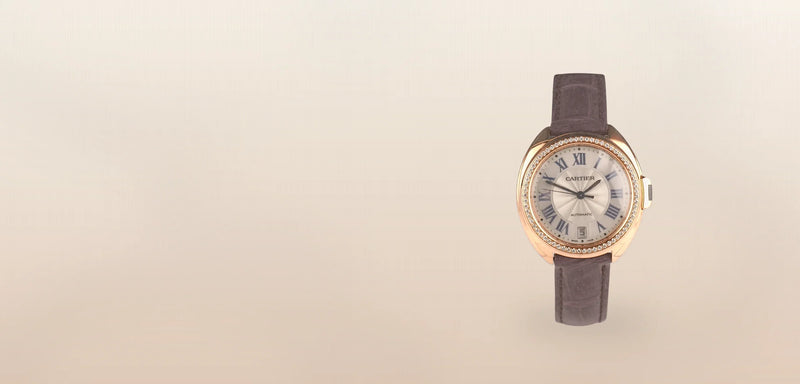
Cartier
Cartier Cle de Cartier 35mm: A Buyers Guide to the Key Crown Dress Watch
The Cle de Cartier story from the 2015 launch, the key crown, the calibre 1847 MC, the rose...
Read the entry →

Breitling
Breitling Navitimer B01 41: A Buyers Guide to the Mint Green Chronograph
The Navitimer story from the 1952 slide rule to the 2022 relaunch, the mint green dial, the calibre...
Read the entry →

journal
Rolex Explorer II 226570: A Buyers Guide to the Black Dial and the Quiet GMT
The 2021 Explorer II 226570, the calibre 3285, the black dial against the Polar, and what to check...
Read the entry →

journal
Omega De Ville Prestige: A Buyers Guide to the Mother of Pearl Dress Watch
How a mother of pearl dial is made, the De Ville story from the Seamaster family to the...
Read the entry →