Journal · journal
Omega Seamaster Planet Ocean titanium chronograph 232.90.46.51.03: the Master Chronometer tool watch explained

Titanium changed the dive watch. For decades the serious tool watch was steel, heavy by design, because weight read as strength. Then watchmakers remembered what aerospace already knew: titanium is as strong as steel at roughly forty percent less weight, it shrugs off salt water, and it does not chill the wrist the way steel does. On a forty five and a half millimetre watch rated to six hundred metres, that is not a footnote. It is the difference between a watch you admire and a watch you wear.
The Seamaster Planet Ocean is Omega's answer to the question of how much watch a diver can actually use. It sits above the Seamaster Diver 300M in the range: six hundred metres of water resistance instead of three hundred, a thicker case, the helium escape valve at ten o clock, and the arrow shaped hands that make a Planet Ocean readable at a glance in poor light. The Diver 300M is the everyday watch. The Planet Ocean is the instrument. In titanium, with the blue ceramic dial and bezel, it is the instrument at its most wearable.
The helium escape valve deserves an honest paragraph. In saturation diving, divers live for days in pressurized chambers breathing helium rich gas. Helium atoms are small enough to slip past a watch's seals and build up inside the case. On the way back up, the trapped gas expands and can pop the crystal off. The valve lets it out. Omega fitted the first escape valves to the Seamaster around nineteen seventy for the Comex saturation divers, and it has been part of the Planet Ocean's silhouette ever since. Will you ever need it. Almost certainly not. But it is a real function with a real history, not decoration, and it is one of the details that separates a Planet Ocean from every other large diver.
The movement inside this watch is the calibre 9900, and it is worth understanding what that means. The 9900 is a column wheel chronograph with a vertical clutch, which are the two features that separate a properly engineered chronograph from a basic one. The column wheel gives the pushers a smooth mechanical feel instead of a mushy one. The vertical clutch means the chronograph seconds hand starts without a stutter and the movement can run the chronograph continuously without extra wear. On top of that, the 9900 is a Master Chronometer. That is Omega's certification with METAS, the Swiss Federal Institute of Metrology, and it goes well beyond the older COSC chronometer test. The watch is tested as a complete cased watch, not a bare movement. It must run within zero to plus five seconds a day. It must resist magnetic fields up to fifteen thousand gauss, which is why Omega can use a silicon balance spring and skip the soft iron inner case, leaving the sapphire back open to show the movement. Sixty hours of power reserve completes the picture.
The dial layout is the two register chronograph: small seconds at nine, a combined twelve hour and sixty minute counter at three, central chronograph seconds, and the date at six. The dial is blue ceramic, glossy and deep, with the ZrO2 engraving that marks Omega's zirconium oxide ceramic. The Seamaster script is picked out in orange, the traditional Planet Ocean accent, echoed on the tip of the chronograph seconds hand. The bezel is blue ceramic with white numerals, unidirectional with a firm click, and the lume plot at twelve is the green dot divers check first.
Titanium has its own buying logic. First, the weight. A titanium Planet Ocean should feel notably lighter than you expect for its size. If it feels like steel, something is off. Second, the finish. Titanium scratches differently from steel and shows handling marks as a soft patina rather than bright scratches. Light marks are normal and honest. Deep gouges on the bezel or lugs are not. Third, the pushers. This is a chronograph with screw down pusher sleeves for the water resistance. Unscrew each pusher, start the chronograph, and confirm the seconds hand sweeps cleanly from twelve, stops crisply, and resets exactly to twelve. Fourth, the bracelet. The titanium bracelet should have even brushing and a clasp that closes with authority. Fifth, the date. Check it changes crisply near midnight and sits centered in the window at six.
A word on the market. The titanium Planet Ocean chronograph has tended to hold its own among modern Omega sports watches, helped by the combination collectors actually ask about: an in house column wheel chronograph, Master Chronometer certification, and a case metal that makes the size livable. It is a lot of watch for the money next to anything Swiss with a comparable movement, and the blue dial version has consistently been the one people reach for first.
The Planet Ocean was never trying to be elegant. It was trying to be the most capable dive watch Omega could build, then Omega made it in titanium so you would actually wear it. That is the whole story, and it is a good one.
From the vault: The Omega Seamaster Planet Ocean chronograph in titanium with the blue ceramic dial and bezel, reference 232.90.46.51.03, is available in our collection at $6,749.99. View the watch here.
Keep reading
More from the Journal
Cartier
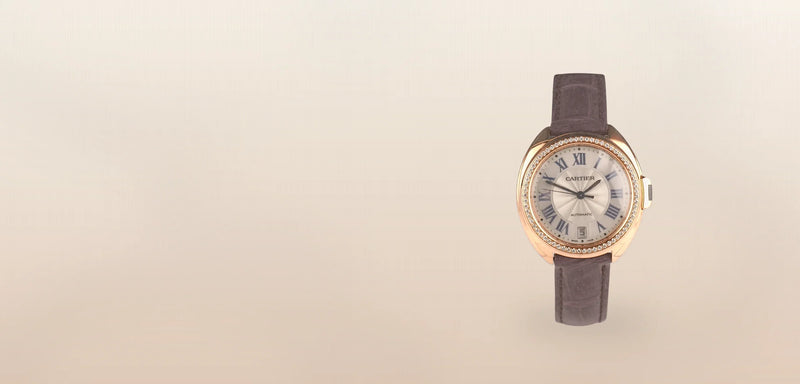
Cartier Cle de Cartier 35mm: A Buyers Guide to the Key Crown Dress Watch
The Cle de Cartier story from the 2015 launch, the key crown, the calibre 1847 MC, the rose...
Read the entry →

Breitling
Breitling Navitimer B01 41: A Buyers Guide to the Mint Green Chronograph
The Navitimer story from the 1952 slide rule to the 2022 relaunch, the mint green dial, the calibre...
Read the entry →

journal
Rolex Explorer II 226570: A Buyers Guide to the Black Dial and the Quiet GMT
The 2021 Explorer II 226570, the calibre 3285, the black dial against the Polar, and what to check...
Read the entry →

journal
Omega De Ville Prestige: A Buyers Guide to the Mother of Pearl Dress Watch
How a mother of pearl dial is made, the De Ville story from the Seamaster family to the...
Read the entry →