Journal · Cartier
Cartier Pasha de Cartier Skeleton 4282: A Buyers Guide

In 1985 Cartier did something it had not done before. It asked Gerald Genta, the designer behind the most famous sports watches of the previous decade, to draw a watch for Cartier. The result was the Pasha, a round watch with oversized Arabic numerals, a screw down crown cap chained to the case, and a confidence that owed nothing to anyone else catalogue. Four decades later the Pasha remains the most distinctive silhouette Cartier makes. The skeleton version takes that silhouette and turns the design into architecture, rebuilding the dial out of the movement itself.
The original story is worth a paragraph because it explains the details. The legend goes that the Pasha of Marrakech wanted a watch he could swim in, and Cartier answered with a water resistant round case, a protective cap over the crown, and a chain so the cap could never be lost. Whether or not every detail of the tale survives scrutiny, the watch it produced was unmistakable: the four large Arabic numerals at twelve, three, six and nine, the chemin de fer minute track, sword shaped hands, Vendome style lugs, and that chained crown with its cabochon. Nothing else looked like it. The Pasha ran through the 1990s as Cartier boldest statement piece, then stepped back while the brand focused elsewhere.
The revival arrived in 2020 as the Pasha de Cartier, and Cartier rebuilt it properly. The collection moved to in house movements, gained the QuickSwitch system that lets straps be swapped without tools, and added SmartLink adjustment on the bracelets for a precise fit. The design codes survived intact: the numerals, the chained crown, the cabochon. What the revival added was a serious watchmaking programme, with complications that put the Pasha back in the conversation with collectors. The moonphase, the flying tourbillon, and the skeleton each took the familiar round case and did something the original never attempted.
The skeleton is the most interesting of the three because it solves a design problem so elegantly. A conventional skeleton watch opens up the dial to show the movement, and the numerals disappear with the dial. Cartier instead shaped the bridges themselves into the Pasha signature numerals. The calibre 9624 MC, an automatic movement developed in house, carries its bridges in the form of the large Roman numerals that define the Pasha face, so the time is still read off numerals even though the dial is gone. Blued steel sword hands sweep over openworked plates, and the whole mechanism reads as jewellery and engineering at once. It is a skeleton that could only be a Pasha, which is rarer than it sounds. Most skeleton watches could wear any brand name. This one cannot.
Technically the watch is a proper Cartier manufacture piece. The automatic calibre runs the hours and minutes with a sweep seconds hand, and the skeletonisation is structural rather than decorative: material was removed from the plates and bridges with the movement still running to full chronometer worthy standards. The open dial means every finish is on display, the bevelling, the straight graining, the jewel sinks, and Cartier finishes to a standard that rewards a loupe. The case is 41 millimetres of stainless steel, the crown keeps its chained cap and cabochon, and the QuickSwitch system means the watch can move from bracelet to leather in seconds. At 41 millimetres it has real presence, though the round case and short lugs keep it wearable.
Wearing it is an exercise in legibility rethought. There is no dial to bounce light back, so the eye reads the blued hands against the depth of the movement, and the numeral bridges do the orienting work a dial normally does. It sounds like it should be hard to read and in practice it is immediate, because Cartier kept the contrast high and the layout faithful to the original Pasha. The watch moves easily between settings in a way few skeleton watches manage. The steel case and the chained crown keep it grounded and sporty, while the openworked calibre gives it the theatre of haute horlogerie. It is a watch that works with a suit precisely because it refuses to behave like a dress watch.
Buying a pre owned Pasha skeleton rewards close inspection, and the open dial is your ally. Start with the bridges. The numeral forms should be crisp and undamaged, with clean bevelling along every edge, and the jewels should sit level in polished sinks. Check the blued hands for scratches or fading, since replacements are not trivial. Work the crown and confirm the cap screws down smoothly on its chain, and check that the cabochon is present and secure. Test the QuickSwitch tabs on every strap that comes with the watch; they should release and lock with a positive click. Look at the bracelet or strap for stretch and wear, and run the automatic winding by hand to confirm the rotor moves freely and the power builds. Ask about service history. An in house skeleton calibre should be serviced by a watchmaker who knows the movement, and a documented service record is worth real money on a watch like this.
The Pasha line has tended to hold steady interest since the 2020 revival, with the complicated references carrying a clear premium over the time and date models. That is a tendency, not a promise, and the skeleton should be bought for what it is rather than what it might do. What it is, is the only skeleton watch in its price class whose design is inseparable from its mechanism. The numerals are the bridges. The bridges are the watch. Genta drew a face in 1985, and Cartier has now built the movement to match it.
From the vault
Cartier 41mm Pasha de Cartier Skeleton Stainless Steel Automatic Mens Watch 4282
In house skeleton calibre, $17,995.00
Keep reading
More from the Journal
Cartier
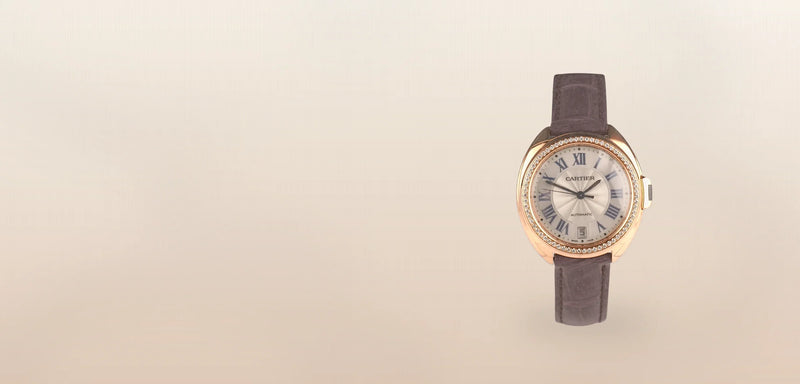
Cartier Cle de Cartier 35mm: A Buyers Guide to the Key Crown Dress Watch
The Cle de Cartier story from the 2015 launch, the key crown, the calibre 1847 MC, the rose...
Read the entry →

Breitling
Breitling Navitimer B01 41: A Buyers Guide to the Mint Green Chronograph
The Navitimer story from the 1952 slide rule to the 2022 relaunch, the mint green dial, the calibre...
Read the entry →

journal
Rolex Explorer II 226570: A Buyers Guide to the Black Dial and the Quiet GMT
The 2021 Explorer II 226570, the calibre 3285, the black dial against the Polar, and what to check...
Read the entry →

journal
Omega De Ville Prestige: A Buyers Guide to the Mother of Pearl Dress Watch
How a mother of pearl dial is made, the De Ville story from the Seamaster family to the...
Read the entry →